In this post · 8 sections
On 30 October 2026, Home Affairs opened a consultation with two halves. Most of the coverage went to the first half, the money: whether your study funds should sit in an Australian bank account. The second half got far less attention. It is about the Genuine Student requirement itself, the test that decides whether a case officer believes you are coming here to study.
None of it is law yet. Submissions close at 12pm AEDT on Monday 23 November 2026. This post covers the Genuine Student side of the paper, the separate interim funds check aimed at Evidence Level 3 countries, who that check would actually hit, and what else is on the table. I already broke down the four Australian bank account models, so I will not repeat them here.
Why this matters
The Genuine Student requirement is where most offshore refusals are decided. Change how it is assessed, and you change what a strong file looks like.
Assistant Minister Julian Hill gave the reason in his 30 October 2026 speech[5]: he is "very concerned about the ongoing high rate of offshore refusals in South Asia". The ICEF Monitor write-up[3] frames the consultation against "high visa refusal rates and falling commencements". ICEF reports that public university commencements are projected to fall 18% year on year, and that IDP and Navitas say refusal rates are deterring students. Those figures come from ICEF's reporting, not from Home Affairs.
The political side matters too. The ABC's coverage of the 30 October announcement[4] framed it as Labor moving to fix its own student visa crackdown. Read alongside ICEF, the pressure came from two places: a sector watching commencements fall, and concern about refusal rates. ICEF also notes the government is keeping its focus on integrity and on stopping visa hopping.
Read together, this is not a pure tightening. It is a rewrite. Some parts may get easier for a well-prepared applicant and some parts will get harder for a weak file.
Who this is for
This is for you if:
- You are planning to lodge a subclass 500 application from India or another South Asian country in 2027.
- You are a parent funding a degree from savings or an education loan.
- You were refused under the Genuine Student requirement and you are deciding whether to reapply.
- You want your view in front of Home Affairs before submissions close.
The Genuine Student side: what is up for a rewrite
Today, the Genuine Student requirement asks whether you genuinely intend to study, judged on your circumstances, your course, and your plans after it. Officers apply it under Ministerial Direction 106. The consultation paper[2] sets out principles for a future version of that direction. Here is what it proposes, in my summary.
Two kinds of student, two kinds of test. The paper separates commencing students from continuing or returning students.
Commencing students. The focus would be on whether your study pathway is credible and achievable: your rationale, how prepared you are, the course and provider, the costs, the outcomes you expect, and whether the information you give is credible.
Continuing or returning students. More weight would go on your record in Australia: your conduct, course progression and outcomes, course changes, gaps, employment and financial patterns, enrolment history, and the value of the further study.
Transnational education. Study through an Australian provider offshore would get positive weight where there is evidence of progression and outcomes. That does not guarantee a grant.
Less reliance on template statements. The paper proposes moving away from formulaic Genuine Student statements, and giving clearer reasons for decisions.
Interaction with funds. Financial capacity stays a separate legal requirement from the Genuine Student assessment. The paper proposes delinking financial capacity from anticipated future earnings in Australia. With revised financial rules in place, the direction could reduce its focus on genuine financial capacity and return the focus to how credible your study pathway is.
If you are a first-time applicant, the question becomes "does this plan make sense", not "can you recite a template". If you are already here, your own record does most of the talking.
One frame matters above all. The paper itself says "No decisions have been made on these proposals", and it calls its models "illustrative" and "not settled Departmental positions". Whatever the final Genuine Student settings are, they will come after this consultation, not before it.
I covered why Indian student visas are being refused earlier this year. The failure patterns in that post (template statements, course mismatch, thin funds history) are the same things any rewrite is aimed at.
The interim funds check for Evidence Level 3
This is the part with the clearest near-term effect. The paper says the bank account models "would require further legal, banking, systems and implementation work". So it proposes an interim step for "primary applicants from Evidence Level 3 countries" in the meantime, and says it "would be a separate, earlier measure and would not predetermine which of the four longer-term options should ultimately proceed."
Same amounts. "Existing prescribed amounts would initially be retained." The current living cost figure is AUD 29,710 for a student, per the subclass 500 page.
Six months of history. "Deposits would be supported by at least six months of transaction history, with a longer period required in higher-risk circumstances."
Fewer funders. "Reliance would generally be limited to the applicant, spouse, parents or another prescribed supporter, with evidence of relationship, ownership, source, access and continuing capacity."
Loans. "Unsecured personal lending and non-disbursed loans would generally not be accepted."
Upfront, regardless of provider. All Evidence Level 3 primary applicants would provide the evidence at lodgement "regardless of provider Evidence Level".
That last point is the real change. Today, a high-rated provider can mean lighter paperwork. Under this measure, your country level would decide it instead.
Who it would hit
Anyone lodging as a primary applicant from an Evidence Level 3 country. The paper does not name the countries, and Home Affairs does not publish country Evidence Levels.
For India, the only source is reporting. On 3 April 2026, Business Standard[6] reported a Rajya Sabha answer saying that "from January 8, 2026, Australian authorities have revised the evidence requirement level for Indian applicants from EL2 to EL3". Levels changed again on 30 September 2026, and I have not seen an official source on India's level since.
In practice, it would hit three kinds of file hardest:
- Funds parked recently. A lump sum that arrived last month will not show six months of history.
- Uncles, cousins and family friends as sponsors. Outside "applicant, spouse, parents or another prescribed supporter", that support may not count.
- Sanctioned but undisbursed loans. A sanction letter alone would generally not be accepted.
What else is on the table
Beyond the four account models, the paper sets some rules that would apply whichever model wins. Each one changes how you plan, even before any account rule exists.
Funds assessed separately from your provider. Every option would "assess financial capacity independently from provider Evidence Level settings".
No future wages. Every option would "exclude prospective earnings from work in Australia". Part-time work cannot be part of your funding case.
Overseas accounts still count, for now. Every option would "allow verified overseas accounts to be used as a transitional arrangement before an Australian account model is operational."
Open questions. The paper lists "pre-arrival account opening, identity verification, fees, exchange rates, privacy, information sharing, refunds" and what happens on "visa refusal, deferral, withdrawal and non-travel" as things design work still has to answer.
The numbers on each account model, and my worked example, are in the bank account post.
The deadline and how to respond
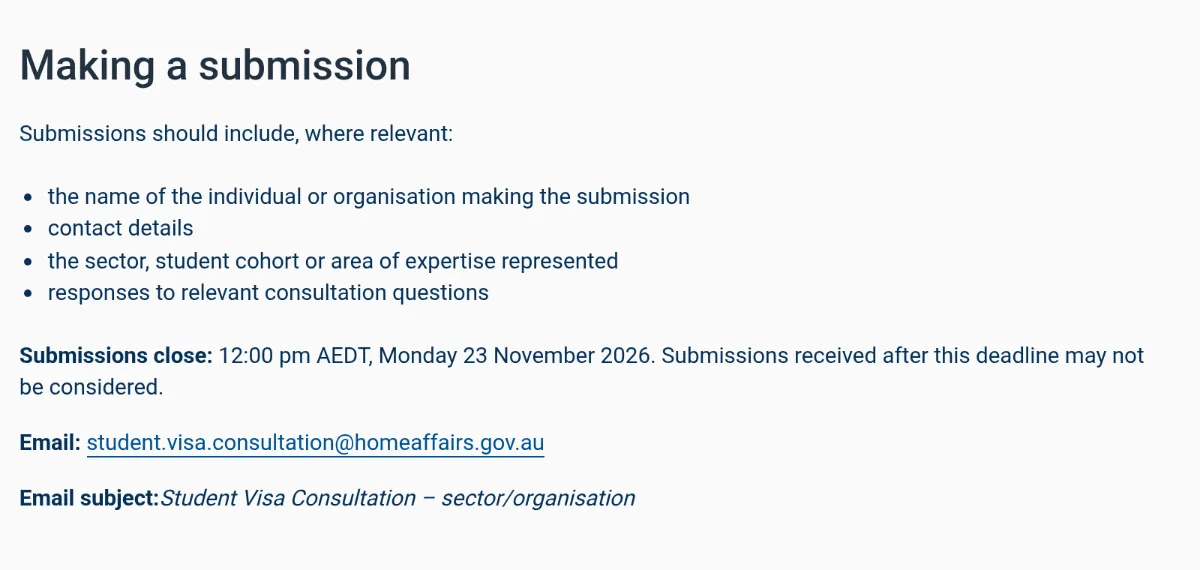
Submissions close at 12pm AEDT on Monday 23 November 2026. You email student.visa.consultation@homeaffairs.gov.au with the subject line "Student Visa Consultation", followed by your sector or organisation, per the consultation page[1].
The page asks for your name, contact details, "the sector, student cohort or area of expertise represented", and responses to the consultation questions. It also warns that "Submissions received after this deadline may not be considered."
Two details make this easier than it sounds. Respondents "do not need to support the approaches outlined", and Home Affairs "will not publish submissions on its website". A student or parent can write one page about a single proposal.
I came here from India on a student visa myself. If I were lodging in 2027, the six-month history rule is the line I would be planning around today.

Planning your move and want the job side sorted early?
I run 1-on-1 strategy sessions for international graduates in Australia. We go through your resume, your target roles, and what the Australian job market will actually expect of you once you land. Visa and funding questions belong with a registered migration agent.
Ketan Shetye · Voice AI Engineer in Australia
What you can do about it
- Do not restructure anything yetNothing in this consultation is in force. If you lodge before any change, the current rules on the subclass 500 page apply.
- Start the six-month clock nowIf you are lodging in mid-2027, the account you will rely on should already be holding funds with a clean transaction history. Under the current rules that does no harm, and under the interim measure it would be the minimum.
- Check who is funding youIf the money comes from anyone other than you, a spouse or a parent, ask a registered migration agent how that would be treated. Do not assume a relative's support will count.
- Get loans disbursed or securedA sanction letter is not disbursement. Ask your lender what a disbursed or secured structure looks like, and when it could happen relative to lodgement.
- Send a submission by 23 November 2026One page is enough. Name the proposal you are responding to, explain how it would affect you, and send it to student.visa.consultation@homeaffairs.gov.au before 12pm AEDT.
Sources and further reading
- homeaffairs.gov.au
Home Affairs, Consultation on proposed reforms to the Genuine Student requirement and financial capacity framework. The official page, the deadline and the submission email. Last updated 30 October 2026.
- homeaffairs.gov.au
Home Affairs, Strengthening the Genuine Student requirement and financial capacity framework (consultation paper). The Genuine Student proposals, the cross-option rules and the interim Evidence Level 3 measure.
- monitor.icef.com
ICEF Monitor, Australian government opens consultation on reforms to Genuine Student test and financial requirements. Trade press coverage from 5 November 2026, a secondary source. Covers Julian Hill at the AIEC, the projected 18% fall in public university commencements, IDP and Navitas on refusal rates deterring students, and the government's integrity and anti visa hopping focus.
- abc.net.au
ABC News, Labor moves to fix student visa crackdown. News coverage of the 30 October 2026 announcement, a secondary source. Frames the reforms as Labor responding to its own crackdown.
- julianhillmp.com
Julian Hill MP, speech to the Australian International Education Conference, 30 October 2026. The minister's stated reasons, including the South Asia refusal concern.
- business-standard.com
Business Standard, Australia puts Indian students under highest visa risk tier. Report of the Rajya Sabha answer on India's move to Evidence Level 3, a secondary source.
Student Visa Australian Bank Account Plan: The 4 Proposed Models. The other half of this consultation, with the numbers on each model.
This post is a summary of a Home Affairs consultation paper and published Home Affairs pages, correct as at 6 November 2026, and it is not immigration or financial advice. I am not a registered migration agent. Everything above is a proposal under consultation, not law, and nothing has changed for applications lodged today. Any final rule could look different, so confirm your own situation with a registered migration agent (MARA).