In this post · 8 sections
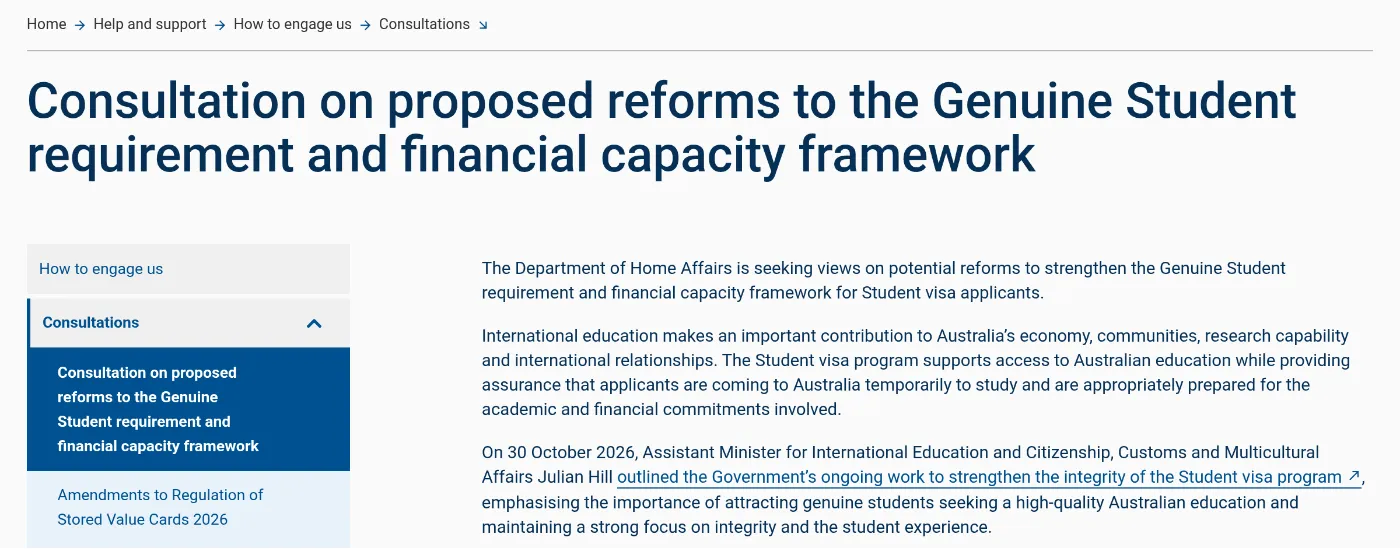
On 30 October 2026, the Department of Home Affairs asked for feedback on proposed changes to student visa financial rules, including a possible Australian bank account requirement. Under three of the four options in its consultation paper, you would ultimately have to hold your study money in an Australian account, in your own name, for at least one or three months depending on the option. Two of those options set the amount at half of your whole course.
None of this is law. No decision has been made, and nothing has changed for an application you lodge today. This post covers what the official paper actually proposes, the separate interim idea aimed at Evidence Level 3 countries, how each option would land for an Indian student, and how to send a submission before the 23 November 2026 deadline.
Why this matters
Right now, money for a subclass 500 visa can sit in an Indian bank. Under the first three options, it would ultimately have to move to an Australian account. That is a big change for families funding a degree.
The paper says it plainly: "No decisions have been made on these proposals."[2] It calls the models "illustrative" and "not settled Departmental positions". Treat it as a warning about direction, not a new checklist.
In his 30 October 2026 speech[4] to the Australian International Education Conference, Assistant Minister Julian Hill said he is "very concerned about the ongoing high rate of offshore refusals in South Asia". I covered why Indian student visas are being refused in an earlier post, so I will not repeat those numbers here.
- 3 April 2026: Business Standard reports India moved to Evidence Level 3 from 8 January 2026. A news report, not a Home Affairs source
- 30 September 2026: Evidence Levels updated again
- 30 October 2026: Home Affairs asks for feedback on the proposals. Same day: Julian Hill's speech to the Australian International Education Conference
- 23 November 2026, 12pm AEDT: Submissions close
Who this is for
This is for you if:
- You are an Indian student planning to lodge a subclass 500 application in 2027 or later.
- You are a parent funding a child's Australian degree from savings in India.
- You are relying on an education loan and want to know if it would still count.
- You want to tell Home Affairs what you think before submissions close.
What the current rules say
Here is today's baseline, from the official Student visa (subclass 500) page[3], last updated 22 October 2026.
What you show. Travel, 12 months of course fees, 12 months of living costs for you and any family coming with you, and school fees for any school-age children who come too.
Living costs. AUD 29,710 for a student, AUD 10,394 for a partner and AUD 4,449 for a child, per 12 months.
Accepted evidence. "Deposits of money from a financial institution", "a government loan or loans from a financial institution", or "scholarships or similar financial support".
Income option. Parents or a partner with a personal annual income of at least AUD 87,856 in the 12 months before you apply, or AUD 102,500 if family members come with you.
The page already warns that "a bank balance certificate across a single day does not show us how you increased your funds". And it says "the best evidence you can provide of genuine access to funds if you are relying on a loan is evidence of disbursement."
Nowhere in the current rules is there an Australian account requirement. The paper confirms that: today, "No specific account or minimum holding period applies".
How the student visa Australian bank account models work
All four options sit in one table in the consultation paper[2]. Below is what the paper says about each, and nothing more.
Option 1: Managed 50% model
Held at least 1 month- Amount
- "50% of total tuition and prescribed living costs for the full course or package of courses."
- Where
- An eligible Australian account in your name
- Holding period
- At least one month before lodgement
- Release
- Then "released on a prescribed schedule"
Option 2: Flexible 50% model
Held at least 3 months- Amount
- The same 50% of full-course costs
- Where
- An Australian account in your own name
- Holding period
- At least three months
- Release
- "No mandatory release schedule."
Option 3: First-year assurance
Held at least 3 months- Amount
- "100% of tuition and prescribed living costs for the first 12 months, or the remaining course if shorter."
- Where
- An Australian account in your own name
- Holding period
- At least three months before lodgement
- Release
- "Managed release could be targeted to defined cohorts."
Option 4: Recognised education finance
Australian account preferred- Amount
- Costs met "through recognised financial institutions, personal funds or a combination"
- Where
- A transfer to an Australian account is "preferred where practicable", with "direct reliance permitted in limited circumstances"
Some points apply to all four. Each option would require evidence of financial capacity at lodgement, and would "assess financial capacity independently from provider Evidence Level settings". Each would "exclude prospective earnings from work in Australia". And each would "allow verified overseas accounts to be used as a transitional arrangement before an Australian account model is operational."
That last line matters. Even if an account model is chosen, the paper allows verified overseas accounts to be used until it is up and running.
What the numbers could look like
The Home Affairs page uses its own example: a course fee of AUD 50,000 for 3 years. I ran that example through the options. These are my calculations, not government figures. They assume the current AUD 29,710 living cost is used for every year, which the paper does not confirm. They also leave travel out of the option figures. The paper does not say how travel would be counted, although it says the framework "would continue to cover tuition, living, travel and relevant family costs", so the real option figures could be higher.
Today. AUD 16,666 of first-year fees (the page's own figure), plus AUD 29,710 living, plus the AUD 2,000 travel guide. My total: AUD 48,376.
Options 1 and 2. Full-course cost of AUD 50,000 plus three years of living at AUD 29,710, which is AUD 139,130. Half of that is AUD 69,565, held in an Australian account for at least one month before lodgement (Option 1) or at least three months (Option 2).
Option 3. AUD 16,666 plus AUD 29,710, which is AUD 46,376. Similar to today, but held in Australia for three months first.
On these assumptions, Options 1 and 2 would ask for more than today, and Option 3 for a similar amount. Across all three, the bigger shift is where the money sits, and for how long.
The interim idea for Evidence Level 3 countries
There is a second, separate proposal. The paper says the account models "would require further legal, banking, systems and implementation work". So it floats an interim measure for "primary applicants from Evidence Level 3 countries" in the meantime. The paper says it "would be a separate, earlier measure and would not predetermine which of the four longer-term options should ultimately proceed." Like the four options, it is only a proposal.
Amounts stay the same. "Existing prescribed amounts would initially be retained."
Six months of history. "Deposits would be supported by at least six months of transaction history, with a longer period required in higher-risk circumstances."
Who can fund you. "Reliance would generally be limited to the applicant, spouse, parents or another prescribed supporter, with evidence of relationship, ownership, source, access and continuing capacity."
Loans. "Unsecured personal lending and non-disbursed loans would generally not be accepted." More weight would go on "secured lending, government-backed lending or recognised education finance arrangements".
Evidence at lodgement. All Evidence Level 3 primary applicants would provide it upfront, "regardless of provider Evidence Level".
Is India Evidence Level 3?
The paper does not name any country. And Home Affairs does not publish country Evidence Levels[6] at all.
What we have is news reporting, not a Home Affairs source. On 3 April 2026, Business Standard[5], an Indian news outlet, reported a written answer to the Rajya Sabha in which India's Minister of State for External Affairs, Kirti Vardhan Singh, said that "from January 8, 2026, Australian authorities have revised the evidence requirement level for Indian applicants from EL2 to EL3".
One caveat. Levels were updated again on 30 September 2026, and I could not find an official source confirming India's level after that. The Document Checklist Tool shows what evidence your passport and provider currently need, so check there.
Also note that Evidence Levels decide paperwork, not queue speed. Study Australia says priority processing "is driven by National Planning Levels via Ministerial Direction 115". I explained how your college sets your visa speed separately.
What the paper leaves open
The practical questions are still open. The paper lists them as things "detailed design would need to address": "pre-arrival account opening, identity verification, fees, exchange rates, privacy, information sharing, refunds", and what happens on "visa refusal, deferral, withdrawal and non-travel".
Opening an account from India. The paper asks whether "pre-arrival Australian account arrangements" are "workable for students in different countries and markets". It does not say which banks would offer them. The Koala News[8], a news site, notes there are questions about "whether Australian banks would be willing and able to open accounts for prospective students who are still overseas".
Own name. Under options 1 to 3, the funds sit in "an Australian account in their own name". Read literally, money held in a parent's name would not meet that wording.
If you are refused. Refunds and refusals are listed as open issues. There is no answer yet.
I came to Australia from India on a student visa myself. Moving a large sum before you even know the outcome is exactly the part I would want answered first.

Planning your move and want the job side sorted early?
I have helped 30+ international students get hired here and 50+ get job-ready. In a 1-on-1 we go through your resume, your target roles, and what the Australian job market will actually expect of you, and I show you where the published rules live so you can check them yourself. Visa and funding questions belong with a registered migration agent.
Ketan Shetye · Voice AI Engineer in Australia
What you can do about it
- Do not move money because of this yetNothing here is in force. If you are lodging soon, the current rules on the subclass 500 page[3] are the ones that apply. Those rules contain no Australian account requirement.
- Build a clean funds trail nowToday's page already wants "recent bank transaction statements showing the history of funds". The interim idea would ask Evidence Level 3 applicants for at least six months. A steady history in the account you will rely on does no harm under any option.
- Check your loan typeThe interim idea would generally exclude "unsecured personal lending and non-disbursed loans". If your plan rests on one, ask your lender about disbursement and security now, and confirm with a registered migration agent.
- Run the Document Checklist Tool before you lodgeEnter your passport and provider in the Document Checklist Tool. It reflects current requirements, which can change after each update.
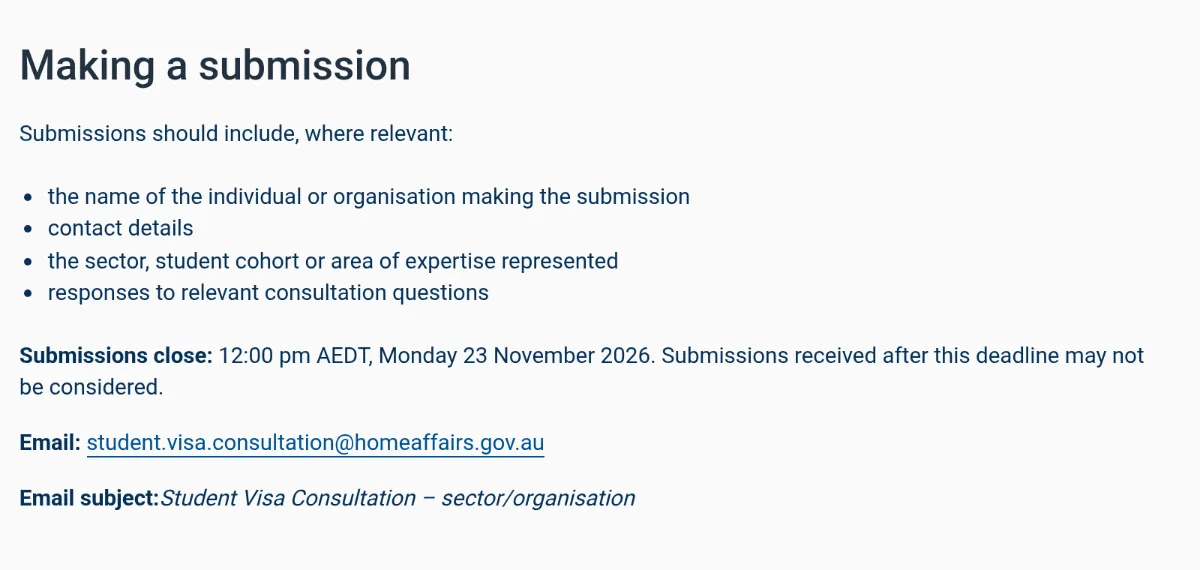
- Send a submission by 23 November 2026Email student.visa.consultation@homeaffairs.gov.au before 12pm AEDT on 23 November 2026. Include your name, contact details, the cohort you represent, and answers to the paper's questions. Respondents "do not need to support the approaches outlined", and Home Affairs "will not publish submissions on its website".
Sources and further reading
- homeaffairs.gov.au
Home Affairs, Consultation on proposed reforms to the Genuine Student requirement and financial capacity framework. The official page, the deadline and the submission email. Last updated 30 October 2026.
- homeaffairs.gov.au
Home Affairs, Strengthening the Genuine Student requirement and financial capacity framework (consultation paper). The four options table, the current settings comparison, and the interim Evidence Level 3 measure.
- immi.homeaffairs.gov.au
Home Affairs, Student visa (subclass 500). Current living costs, income option, accepted evidence and the fee example used above. Last updated 22 October 2026.
- julianhillmp.com
Julian Hill MP, speech to the Australian International Education Conference, 30 October 2026. The minister's reasons, including the New Zealand deposit comparison.
- business-standard.com
Business Standard, Australia puts Indian students under highest visa risk tier. Indian news report from 3 April 2026 of the Rajya Sabha answer on India's move to Evidence Level 3, a secondary source.
- studyaustralia.gov.au
Study Australia, Evidence Level update: September 2026. Confirms Evidence Levels are not published and were updated on 30 September 2026.
- thepienews.com
The PIE News, Australia consults on student visa overhaul. Trade press coverage from 30 October 2026, a secondary source.
- thekoalanews.com
The Koala News, Australian bank accounts among proposed student visa reforms. Secondary news analysis of the practical gaps, 2 November 2026.
This post is a summary of a Home Affairs consultation paper and published Home Affairs pages, correct as at 4 November 2026, and it is not immigration or financial advice. I am not a registered migration agent. Every model above is a proposal under consultation, not law, and nothing has changed for applications lodged today. Any final rule could look different, so confirm your own situation with a registered migration agent (MARA).