In this post · 8 sections
Only 52.2% of international postgraduate coursework graduates who were available for full-time work had it, about four to six months after finishing. Domestic graduates at the same level sat at 88.3%. That is the headline of the 2025 Graduate Outcomes Survey International Report[1], from the Australian Government funded survey that tracks graduate employment rates for international students in Australia. And the reported gap is wider than it was a year earlier, although the report says part of that comes from a change in its method.
The report also asks graduates why they are stuck in jobs below their skills. For international postgraduate coursework graduates, the top answer was not a lack of experience. It was "Do not have permanent residency". This post covers the 2025 numbers at every study level, what changed from 2024, what the report says about PR in its own words, where Indian graduates sit, and what you can do about it on a 485.
| Category | Value |
|---|---|
| International graduates | 52.2% |
| Domestic graduates | 88.3% |
Source: QILT, 2025 Graduate Outcomes Survey International Report
Why this matters
If you finished a postgraduate coursework degree here, you are at the study level with the biggest full-time gap in the report. The difference is 36.1 percentage points. That is my calculation from Table 19 (88.3 minus 52.2). For undergraduates it is 24.6 points (my calculation from Table 18, 75.4 minus 50.8).
Most of you are working. The problem is the kind of work.
Here is the part that should change how you job hunt. When the survey asked international postgraduate coursework graduates why they were in a job that did not fully use their skills, "Do not have permanent residency" came first, at 22.8%. The report's own explanation points to a hiring filter, not a skills problem. A filter is something you can plan around.
If you are still deciding whether to enrol, I looked at whether a master's in Australia is worth it for jobs, including where graduates are three years later.
| Category | Value |
|---|---|
| International graduates | 22.8% |
| Domestic graduates | 0.2% |
Source: QILT, 2025 Graduate Outcomes Survey International Report, Table 3
Who this is for
This is for you if:
- You are on a 485, or about to apply for one, and you keep losing out to a "citizens or PR only" line.
- You have finished a postgraduate degree here and are working below your qualification while you search.
- You are an Indian graduate and want to know how your cohort actually did in the official numbers.
- You are still studying and want to see the job market from the other side of graduation.
Graduate employment rates for international students in 2025
The survey invites graduates about four to six months after they finish. The 2025 International Report covers international graduates who completed their course onshore in Australia and responded between November 2024 and May 2025. It collected 39,536 valid responses from international graduates at 119 institutions, including 42 universities, for a response rate of 33.7%.
- November 2024 to May 2025: International graduates respond to the survey. 39,536 valid responses, 119 institutions
- June 2026: QILT publishes the 2025 International Report
- 4 November 2026: This summary, correct as at this date
First, the full-time employment rate. Full-time means 35 hours or more a week across all jobs, counted as a share of graduates who were available for full-time work.
| Category | International | Domestic | International compared with Domestic |
|---|---|---|---|
| Undergraduate | 50.8% | 75.4% | 24.6 pts lower |
| Postgraduate coursework | 52.2% | 88.3% | 36.1 pts lower |
| Postgraduate research | 71.8% | 84.0% | 12.2 pts lower |
Source: QILT, 2025 Graduate Outcomes Survey International Report
Now the other three measures. Overall employment counts any job at all, and here the gap is smaller.
| Category | International | Domestic |
|---|---|---|
| Undergraduate | 70.7% | 89.2% |
| Postgraduate coursework | 73.7% | 93.6% |
| Postgraduate research | 84.0% | 90.9% |
Source: QILT, 2025 Graduate Outcomes Survey International Report
Labour force participation, international against domestic, was 74.9% against 88.0% for undergraduates, 87.1% against 93.0% for postgraduate coursework, and 91.8% against 92.3% for postgraduate research.
International coursework postgraduates were in the labour force at 87.1%. They were working, actively looking or waiting to start a job. Barely half of those available for full-time work had it.
The postgraduate coursework salary gap is AUD 35,300, the largest at any level. The international median fell from AUD 70,000 in 2024 to AUD 69,400, while the domestic median rose from AUD 100,000 to AUD 104,700. International salaries only count graduates working full-time in Australia.
| Category | International | Domestic |
|---|---|---|
| Undergraduate | AUD 70,000 | AUD 77,000 |
| Postgraduate coursework | AUD 69,400 | AUD 104,700 |
| Postgraduate research | AUD 100,000 | AUD 109,100 |
Source: QILT, 2025 Graduate Outcomes Survey International Report
Field still matters. At postgraduate coursework level, the report says the largest full-time gaps were in the two biggest study areas: Business and management at 53.3% against 92.2% domestic, and Computing and information systems at 44.4% against 81.5%. I already covered which degrees actually get international grads hired using the 2024 survey, so I will not repeat the field tables here. If you are weighing up IT in Melbourne or elsewhere in Victoria, I set out what QILT does and does not publish for Victorian universities.
What changed from 2024, and the catch
In the 2024 survey, the international full-time rate was 52.3% for undergraduates and 56.1% for postgraduate coursework. In 2025 both reported rates fell, to 50.8% and 52.2%. Research graduates fell from 77.5% to 71.8%. The report says domestic rates "remained relatively stable or increased slightly".
| Category | 2025 survey | 2024 survey | 2025 survey compared with 2024 survey |
|---|---|---|---|
| Undergraduate | 50.8% | 52.3% | 1.5 pts lower |
| Postgraduate coursework | 52.2% | 56.1% | 3.9 pts lower |
| Postgraduate research | 71.8% | 77.5% | 5.7 pts lower |
Source: QILT, 2025 Graduate Outcomes Survey International Report
Now the catch. In 2025 the survey stopped counting graduates who were not working and only looking passively as part of the labour force. The report says 2025 full-time rates "are not directly comparable with earlier years", and that the gap widened partly because domestic rates got a bigger boost from the change.
But look at the direction. The Department of Education estimate in Appendix 1 is that the change put upward pressure on international full-time rates, of around 2.5 to 3.5 percentage points for undergraduates and less than 1.5 points for coursework postgraduates. International rates still fell. On those estimates, the method change does not explain the drop, and if anything it made the 2025 figures look slightly better. That is my reading of Table 15, not a conclusion the report states, and the report still says to treat comparisons with earlier years with caution.
The PR barrier, in the report's own words
Graduates were asked whether their job fully used their skills and education. Among international postgraduate coursework graduates employed full-time, 38.7% felt overqualified. For domestic graduates it was 28.3%.
| Category | Value |
|---|---|
| International graduates | 38.7% |
| Domestic graduates | 28.3% |
Source: QILT, 2025 Graduate Outcomes Survey International Report, Table 2
Those who felt overqualified were then asked for the main reason. Here is Table 3 for international postgraduate coursework graduates:
| Category | Value |
|---|---|
| Do not have permanent residency | 22.8% |
| Not enough work experience | 15.3% |
| Entry level job or career stepping stone | 14.3% |
Source: QILT, 2025 Graduate Outcomes Survey International Report, Table 3
For domestic postgraduate coursework graduates, the same three reasons were 0.2%, 7.7% and 11.3%. Here is the table itself.
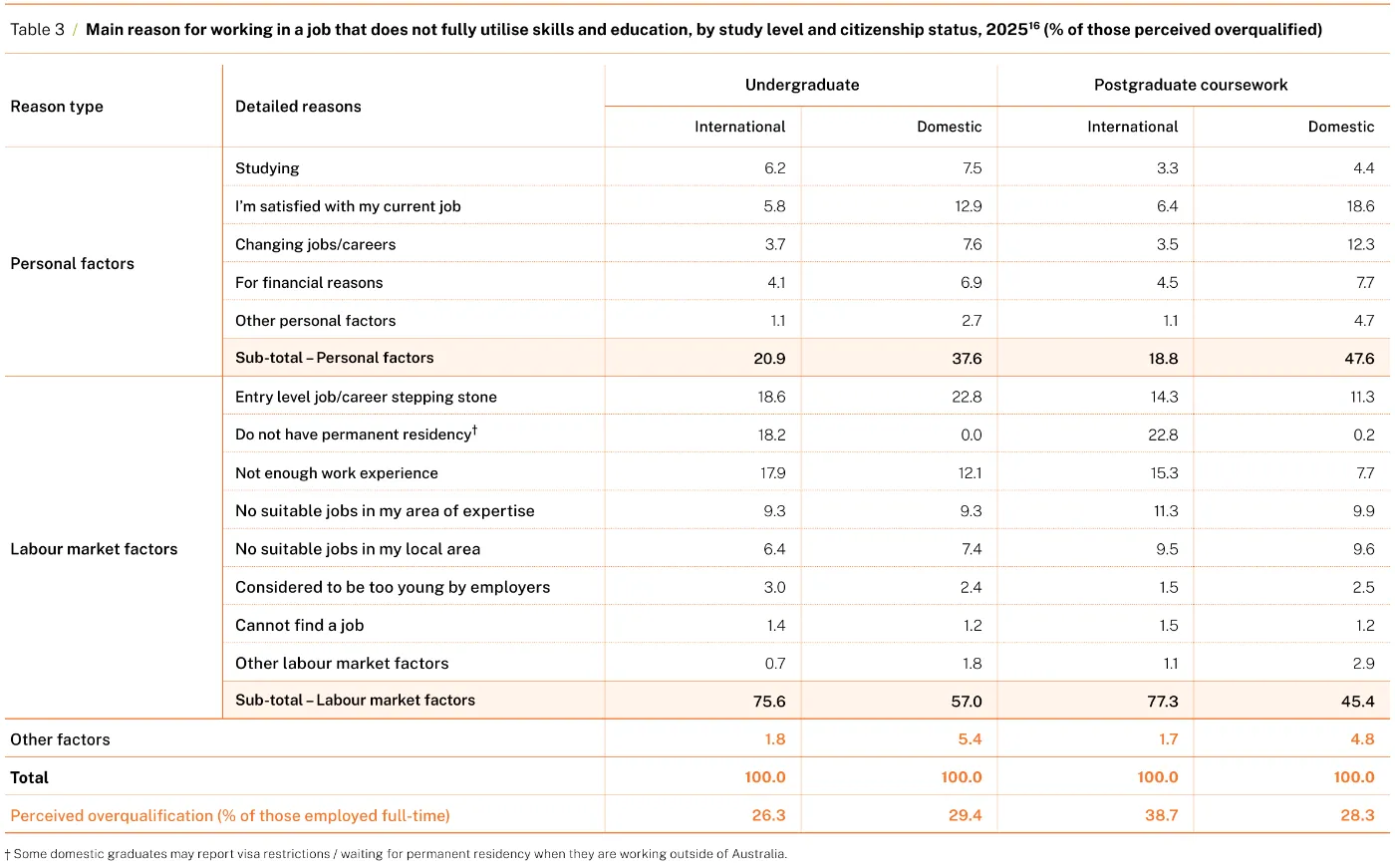
The report's explanation is blunt, on page 19:
"The perception of international graduates that their residency status is a barrier to obtaining relevant work likely stems from some employers restricting job applications to citizens or permanent residents only. This practice, common for managerial or professional occupations, can preclude international graduates with post-study temporary work visas from applying, despite being eligible to work in Australia."
Note the words "likely stems". The survey measured what graduates reported. The employer behaviour is the report's explanation, not something it counted. The same page adds that "These barriers have continued to be reported by international graduates since 2021".
One correction. The report's text calls PR the most often cited reason for undergraduates too, at 18.2%. Its own Table 3 puts "entry level job/career stepping stone" slightly ahead, at 18.6%. The Koala News[5], a secondary news site, called PR the second reason for undergraduates, which matches the table. For postgraduates, PR is clearly first.
The visa shows up in two more places in the report.
Hours. Among international graduates working part-time who wanted more hours, "visa restrictions / waiting for permanent residency" was the main reason for 14.4% of undergraduates and 11.2% of postgraduate coursework graduates. For domestic graduates it was 0.1% and 0.0%.
Not working at all. Among international graduates outside the labour force, between 4.9% and 8.8% across study levels cited visa restrictions as the reason they were not available for work.
Two caveats, because the report makes them itself. International postgraduate coursework graduates are much younger: 74.1% were aged 30 and under, against 32.2% of domestic ones. And international graduates are almost twice as likely to go straight into further full-time study. The report says both partly explain the lower full-time rates. For coursework postgraduates, PR is the barrier named most, not the only one.
Where Indian graduates sit
India was the largest source country among international postgraduate coursework respondents, at 23.5%. Table 9 is the one to read.
| Category | India | All international |
|---|---|---|
| Full-time employment | 45.1% | 52.2% |
| Overall employment | 74.2% | 73.7% |
| Labour force participation | 89.2% | 87.1% |
| In further full-time study | 13.6% | 16.5% |
Source: QILT, 2025 Graduate Outcomes Survey International Report, Table 9
The median full-time salary was AUD 65,000 for Indian postgraduate coursework graduates, against AUD 69,400 for all international postgraduate coursework graduates.
Look at the 89.2% participation next to the 13.6% in further study. My reading of Table 9: Indian postgraduates were less likely than the international average to be in further study (13.6% against 16.5%) and more likely to be in the labour force (89.2% against 87.1%), yet they found full-time work at a lower rate (45.1% against 52.2%). The report describes the India and Bhutan results as "suggestive of graduates who are recent entrants to the labour market".
At undergraduate level the picture flips. Indian graduates had the highest full-time rate of the top five source countries, 54.1%, with a median salary of AUD 73,000.
I am on a 485 myself, so I do not read this report as an observer. I read it as one of the people it describes.

On a 485 and losing interviews to a PR checkbox?
I run 1-on-1 strategy sessions for international graduates in Australia. We go through your resume, your target roles, and which employers on your list actually hire on a 485, and I show you where the published figures live so you can check them yourself. Visa eligibility questions belong with a registered migration agent.
Ketan Shetye · Voice AI Engineer in Australia
What you can do about it
- Find your own row before you read the headlineYour study level, field and source country sit in Tables 8, 9, 18 and 19 of the report. The average is not you.
- Screen every ad for the PR line before you applyThe report says the PR barrier likely stems from some employers restricting applications to citizens or permanent residents. Search each ad for "citizen" and "permanent resident" before you write a word. I built a list of companies that hire 485 visa graduates, and the ones that will not, with the exact line from each careers page.
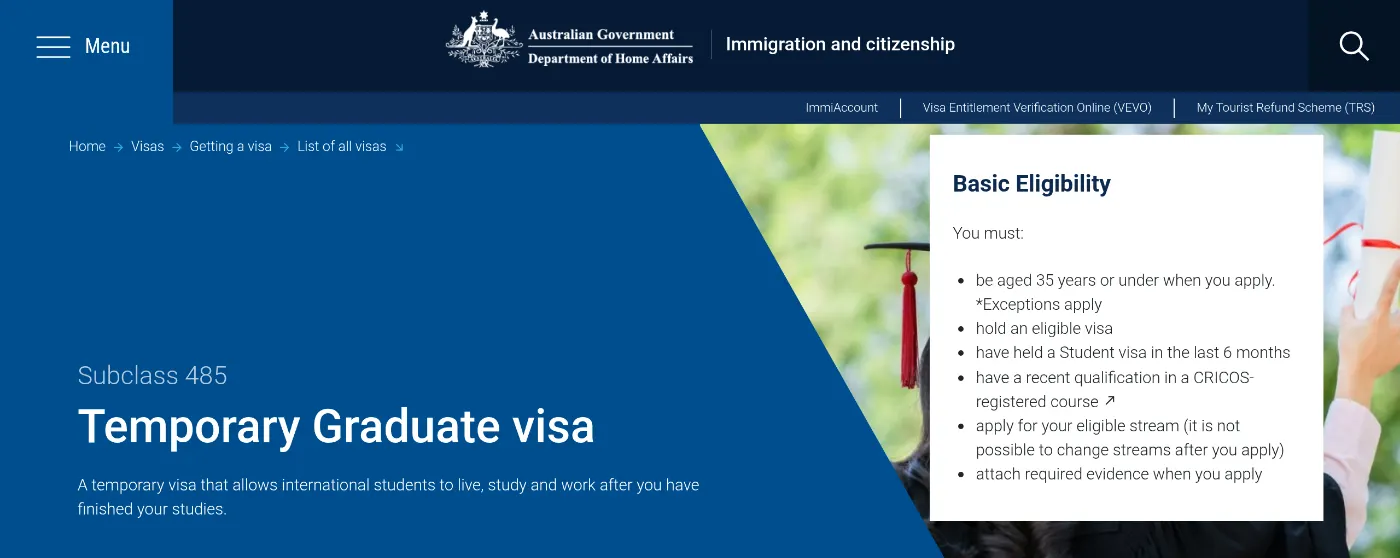
- Answer the work rights question before they ask itHome Affairs describes the 485 as letting you "live, study and work in Australia temporarily", and says "You must find your own employment while on this visa." Check your own grant conditions in VEVO, then put your visa type and expiry date near the top of your resume. A recruiter who has to guess will often guess no.
- Close the experience gap the report namesAfter PR, the next reasons international coursework postgraduates gave were not enough work experience and an entry level or stepping stone job. The report itself points to "targeted opportunities to gain relevant work experience". Contract, project and graduate program roles in your field all count.
- Plan the sponsorship step while the 485 clock runsHome Affairs says the Post-Higher Education Work stream usually lets you stay "between 2 and 3 years, depending on your qualification". If PR is the filter, the long game is an employer who can nominate you. I set out the published 482 sponsorship rules step by step, starting with the salary test on the role.
Sources and further reading
- qilt.edu.au
QILT, 2025 Graduate Outcomes Survey International Report. The primary source for every rate, salary and reason above. Published June 2026.
- qilt.edu.au
QILT, Graduate Outcomes Survey. The survey home, with the 2025 data tables and definitions.
- immi.homeaffairs.gov.au
Home Affairs, Temporary Graduate visa (subclass 485). The official visa page and its streams.
- immi.homeaffairs.gov.au
Home Affairs, 485 Post-Higher Education Work stream. The stay period and the "find your own employment" line. Last updated 12 October 2026.
- thekoalanews.com
The Koala News, Graduate Outcomes Survey highlights permanent residency barrier. Secondary news coverage from 7 July 2026. Its ranking of the PR reason for undergraduates matches Table 3.
Which Australian Degrees Actually Get International Grads Hired. The field-by-field view from the 2024 survey.
This post is a summary of the 2025 Graduate Outcomes Survey International Report and published Home Affairs material, correct as at 4 November 2026, and it is not migration, legal or financial advice. I am not a registered migration agent. Survey rates are averages across thousands of graduates, not predictions for you, and the 2025 figures are not directly comparable with earlier years. For anything about your own visa, confirm your situation with a registered migration agent (MARA).