In this post · 9 sections
On 19 September 2026, the skilled visa queue was re-ordered again. Directions 121 and 122 replaced Direction 119 after less than two months, and for the 482 the change is bigger than it looks.
Under Direction 119, a healthcare or construction worker only got a priority band if they applied from inside Australia. Under Direction 121, as Home Affairs summarises it, the top band carries no location condition, and it now includes agriculture, aquaculture, fishing and resources. This post covers the new 482 order, who is actually fast now, what the published processing times say, and what it means if you are hunting for a sponsor.
Why this matters
For a sponsorship hunter, processing order is not an abstract policy detail. It changes how an employer feels about sponsoring you.
A sponsor in a top-band sector can now tell a hiring manager that their application will be picked up first. A sponsor outside it cannot. That changes which employers are willing to wait, and which roles are worth your applications.
I covered the full Direction 119 tier list in August. That post is now history for anyone lodging today. This one is the practical version: who is fast now.
One caveat, the same as last time. Priority is queue position. It is not eligibility, and it is not a promise about how long anything takes.
Who this is for
This is for you if:
- You are on a 485 and looking for an employer to sponsor you on a 482.
- You work in, or could pivot into, engineering, construction, agriculture or resources.
- You have a 482 nomination or visa application lodged and want to know where it now sits.
- You read the Direction 119 post and want to know what changed.
The new 482 order under Direction 121
Here is the order exactly as the Home Affairs skilled visa processing priorities page[1] states it, highest first.
Priority 1. "Visa applications relating to Construction, Healthcare, Teaching, Agriculture, Aquaculture, Fishing, and Resources sectors, or Australia's law enforcement and defence interests."
Priority 2. "Visa applications in the Specialist Skills stream of the Skills in Demand visa."
Priority 3. "Visa applications where the applicant was in Australia at the time they lodged their application."
Priority 4. "Visa applications where the primary applicant was outside of Australia at the time they lodged their application and whose application is not combined with another person's application at any time."
Priority 5. "All other visa applications."
It covers the Skills in Demand (subclass 482) visa and the older Temporary Skill Shortage (subclass 482) visa, which the Skills in Demand visa replaced on 7 December 2024.
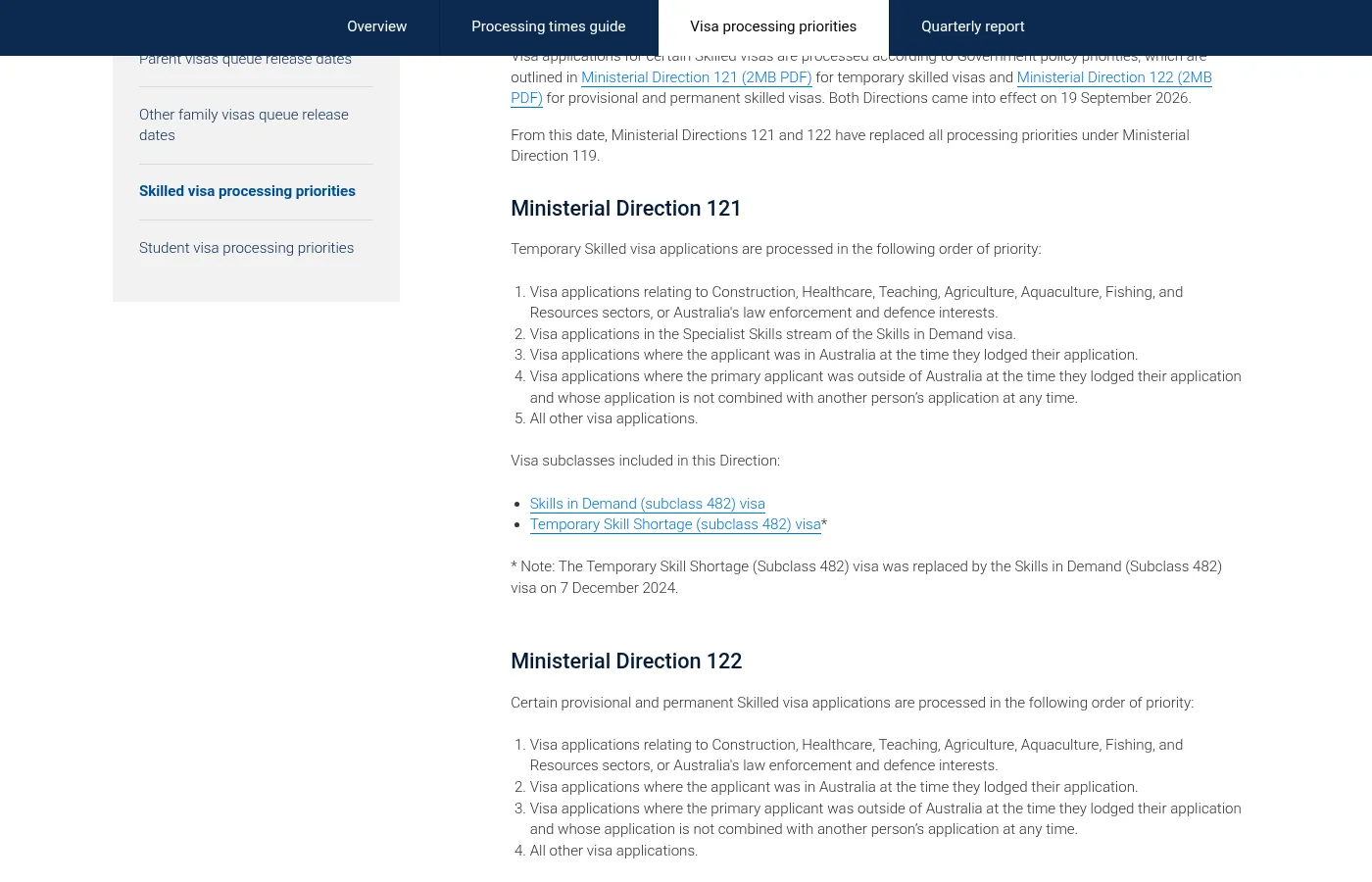
Direction 122 runs the same logic for provisional and permanent skilled visas, in four steps: the same top band, then onshore applicants, then offshore applicants not combined with another application, then everything else. There is no Specialist Skills step, because that stream only exists in the 482.
What changed from Direction 119
Three changes matter if you are job hunting.
The location condition on the sectors is gone, as Home Affairs words it. Under Direction 119, construction, healthcare and teaching only got a band "in Australia". Offshore, a registered nurse fell to the bottom tier. The Direction 121 summary has no location wording on the top band. That is the summary's wording. I have not confirmed it against the full text of Direction 121, so do not treat it as a ruling on your case.
Four new sectors. Agriculture, aquaculture, fishing and resources sit in the top band for the first time. KPMG's October 2026 alert[4] describes the broadened group as also covering mining, and oil and gas.
Specialist Skills gets its own band. High earners on the Specialist Skills stream now come second, ahead of every onshore applicant outside the top sectors. KPMG confirms Specialist Skills is now priority group 2.
The result: an onshore software engineer on a standard 482 nomination has moved from priority 4 of 5 to priority 3 of 5, but with a much bigger group ahead of them.
What counts as a sector
This is the part I could not settle from the Home Affairs summary alone. The page says applications "relating to" those sectors. It does not say whether that means your occupation code, your employer's industry, or both.
Under Direction 119, the sectors were defined by ANZSCO groups. Construction, for example, included Civil Engineering Professionals (Unit Group 2332) and Construction Managers (Unit Group 1331). The Home Affairs summary of Direction 121 lists sectors, not codes. The scope is set by the full text of Direction 121, which is linked from the processing priorities page[1]. I have not confirmed from it whether the sectors are still defined by ANZSCO codes, which codes sit under the new sectors, or whether an employer's industry counts.
Until that is confirmed, do not assume a software engineer at a mining company is in the resources band. The code on your nomination is the safer assumption.
Who is fast now
Based on the order above, here is where common sponsorship profiles land. These placements are my reading of the Home Affairs summary, not a ruling on any individual case.
Civil, structural and other construction engineers. Top band, if their occupation sits in the construction definition in Direction 121.
Nurses, allied health, teachers, tradies. Top band. Unlike under Direction 119, offshore applicants appear to be included too.
Agriculture, aquaculture, fishing and resources. Top band for the first time, and KPMG adds mining, and oil and gas. Which occupations count is set by the full Direction, not by the sector name, so do not assume yours is in.
Specialist Skills stream. Second band, whatever the occupation. This is the high-income stream of the 482. Check the current income threshold on the Home Affairs Specialist Skills stream page.
IT, finance, marketing and most office roles, onshore. Third band. Still processed, still ahead of offshore, but behind everyone above.
The same roles, offshore. Fourth or fifth band.
I am in the third band myself. I am on a 485 in Queensland, and Voice AI Engineer is not in any of those sectors. Nothing about that makes sponsorship impossible. It means the queue is not on my side, so the rest of the application has to be.
What the published processing times say
KPMG's Flash Alert 2026-267[4], its Immigration Update for Q3 2026 published on 26 October 2026, reports the published processing times for the 482:
Specialist Skills stream. Up to 78 days, up from 57.
Core Skills stream. Up to 9 months, down from 10.
Those are published ranges, not promises. Times vary from case to case, and Home Affairs keeps its current figures in the processing times guide[5]. Priority decides when an application is picked up. A decision-ready application, complete on the day it is lodged, is the part you control.
Related: I explained why the Australia priority occupation list 2026 is not the CSOL, and why a valid 482 can still be slow, using the official processing times guide.
What this means for your sponsorship hunt
If you are in a top-band sector, use it. A sponsor who knows the application will be picked up first is an easier sponsor to convince. Say so in your conversations.
If you are not, the honest move is to look at where your skills overlap with the top band. A data analyst at a mining company, a software engineer at an agritech firm, or a project coordinator at a construction company may still sit in the third band on occupation. But those employers sponsor more often, because they are used to it. I listed the niche sectors that sponsor with less competition, including mining tech and agritech, in an earlier post.

Not in a fast-lane sector? Make the rest of the case stronger.
I run 1-on-1 strategy sessions for international graduates in Australia. We go through your resume, your target roles, and the employers in your field with a real sponsorship track record, so your application is worth waiting for. Visa eligibility questions belong with a registered migration agent.
Ketan Shetye · Voice AI Engineer in Australia
What you can do about it
- Find your real ANZSCO codePull it off your skills assessment or draft nomination. The code decides the band, not the title on your contract. Then check it against the Direction 121 definitions once you have read them.
- Check whether your employer's sector mattersUntil the definitions are confirmed, do not assume an employer in mining or agriculture puts you in the top band. Ask the sponsor's migration agent directly.
- Make the application complete on day onePriority only decides when an application is picked up. A decision-ready file is what lets it move once it is. Get the skills assessment, English results and employment evidence ready before the nomination is lodged.
- Target employers that already sponsorSector speed helps, but a sponsor who has done it before matters more. Start with the accredited sponsor list if you are in IT, and check the cost a sponsor actually carries before you pitch.
Sources and further reading
- immi.homeaffairs.gov.au
Home Affairs, Skilled visa processing priorities. The department's summary of Directions 121 and 122, including the five-step 482 order quoted above. Accessed 4 November 2026.
- immi.homeaffairs.gov.au
Home Affairs, Ministerial Direction 122, full text. Signed 18 September 2026, it sets the order for provisional and permanent skilled visas.
- immi.homeaffairs.gov.au
Home Affairs, Ministerial Direction 121, full text. Linked from the skilled visa processing priorities page. It holds the sector definitions this post could not confirm.
- assets.kpmg.com
KPMG, Flash Alert 2026-267: Immigration Update Q3 2026. Published 26 October 2026, a secondary source. Confirms the broadened priority group 1 (including mining, and oil and gas), Specialist Skills as priority group 2, and published processing times of up to 78 days for Specialist Skills and up to 9 months for Core Skills.
- immi.homeaffairs.gov.au
Home Affairs, processing times guide. Official timeframes by subclass. Priority order and processing time are two different things.
Priority Occupation List 2026: All 5 Direction 119 Tiers. The previous order, the full ANZSCO lists Direction 119 used, and why it was replaced.
This post is a summary of published Home Affairs material, correct as at 6 November 2026, and it is not immigration advice. I am not a registered migration agent. Priority affects the order applications are picked up, not how long a decision takes and not whether it is approved. Processing times quoted here are published ranges reported by KPMG, and they vary by case. Every case turns on its own facts, so confirm your own situation with a registered migration agent.