
In this post · 8 sections
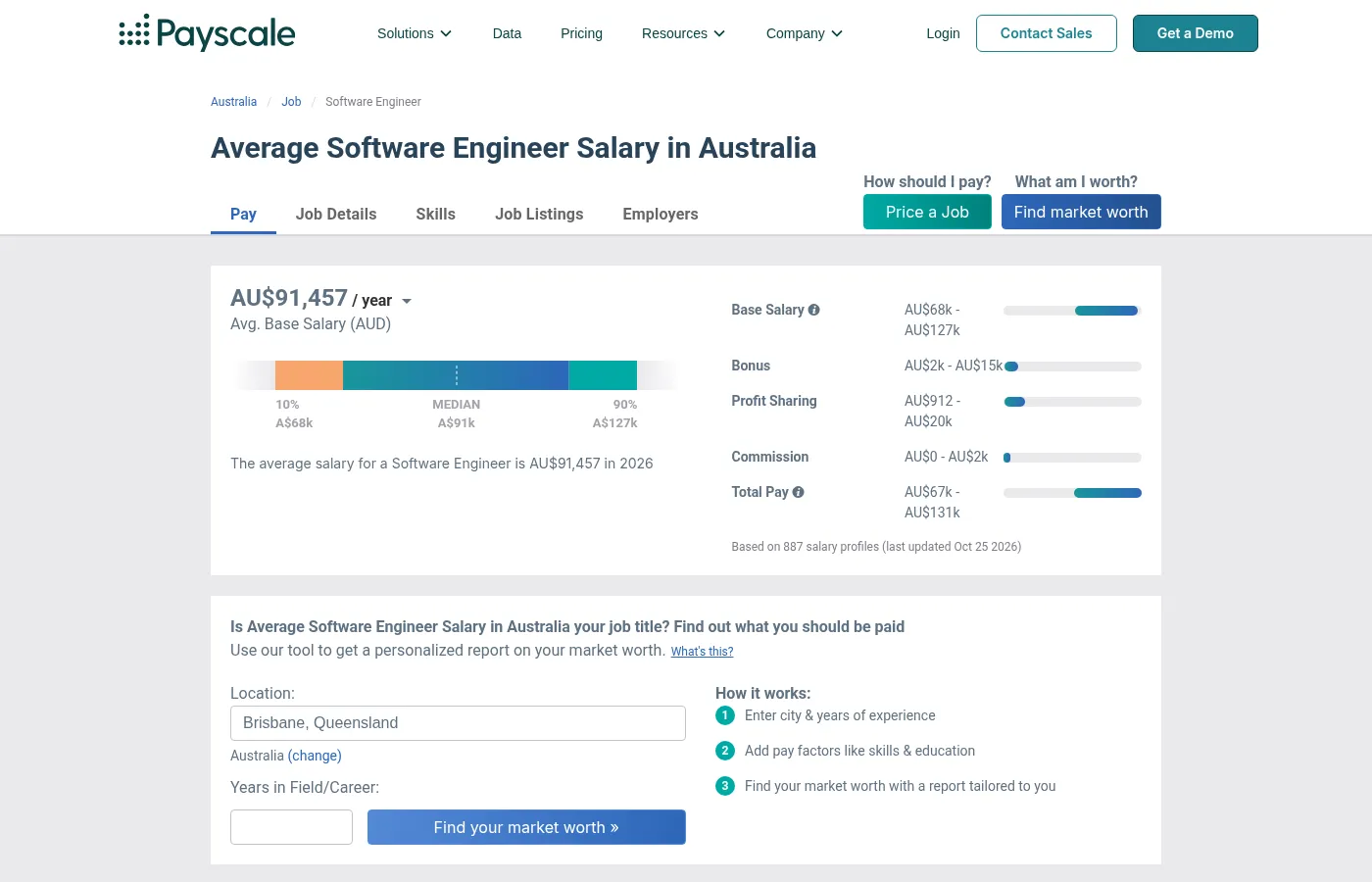
Update, 13 November 2026: The salary figures in this post were pulled in May 2026. Salary sites refresh all the time, and several of them have moved since. PayScale AU[6] now shows a Software Engineer median of A$91k (last updated October 2026), below the $110K in the table. Read the table as a May 2026 snapshot, and check the live pages before you plan around any single number.
I pivoted from Mechanical to Software in my Master's, and from Software to Voice AI 2 years later. Same person. Three different brackets.
The thing that changed was not the degree on the wall. It was the toolkit on my laptop.
Australia in 2026 is paying for that toolkit, not the title on your business card. I pulled salary figures from PayScale AU, Robert Half AU 2026, ERI SalaryExpert AU and aitalentondemand.com.au[4] across 5 career streams. Then I lined up the no-AI base against the with-AI specialist base.
This post breaks down the gap stream by stream, the named AI skill that lifts each bracket, and the 90-day plan to prove it.
The gap, averaged across the 5 streams in May 2026, was +$44K base.
This is not a "learn AI and become an AI Engineer" pitch. The streams below stay in their lane. The Software Engineer stays a Software Engineer. The Data Analyst stays a Data Analyst.
What changes is the named AI skill attached to the role, and the bracket the role then commands.
Why this matters
In 2026 Australia, the gap between the no-AI base and the with-AI base averaged $44K across these five streams when I pulled the numbers in May. The biggest single jump ran from $81K to $147K.
That is not a future trend. It is what the market was paying.
Add the named AI skill that fits your stream and you move into the bracket above. Skip it and you stay in the one below, while the same chair pays more to the person who did not.
Who this is for
This is for you if:
- You are a software engineer, data analyst, mechanical engineer, marketer or finance analyst weighing an AI specialisation.
- You want a higher salary bracket without leaving your industry or retitling as an AI Engineer.
- You have 90 days and want one portfolio artefact that proves the bracket above you.
- You are planning the next 12 months of skill-building around what Australian employers actually pay for.
The gap, stream by stream
| Stream | No-AI base | With-AI base |
|---|---|---|
| Software Engineer (mid-career) | $110K | $152K |
| Data Analyst | $89K | $130K |
| Mechanical / Automation | $83K | $115K |
| Marketing Manager | $89K | $129K |
| Financial Analyst | $81K | $147K |
| Average | $90K | $135K |
Figures as pulled in May 2026. Sources sit at the bottom of the post.
Sydney pays slightly higher than the national figure across all 5, regional slightly lower.
The biggest gap is Financial Analyst into Quantitative Analyst. The smallest is Mechanical into Automation Engineer. Both are real pivots people are making in 2026.
Read the table as a snapshot, not a promise
Salary sites move every month, and each one samples different people. As of late October 2026, PayScale AU's median for a Software Engineer is A$91k, and its Quantitative Analyst figure (A$100k) rests on only 12 salary profiles.
The direction of the gap is the point. The exact dollar figure is not. Check the live page for your own title, city and years before you put a number in a negotiation.
The AI skill that actually lifts each bracket
The mistake people make is treating "AI" like one thing. It is not.
The AI that lifts a Software Engineer salary is a different stack from the AI that lifts a Financial Analyst salary. The streams reward different toolkits.
1. Software Engineer → AI-augmented Software Engineer
Add this skill: Copilot, Cursor and LangChain (RAG + agent workflows). 📊 Bracket lift: $110K → $152K base.
The lift here is not "I used Copilot for autocomplete". The lift is "I shipped a production feature where the LLM is the runtime, not a sidecar".
Production RAG, agent orchestration, prompt-eval frameworks. Companies will pay an AI specialist premium for an engineer who can stand up a LangChain agent against their internal data and ship it without breaking.
The cheapest route in is a single production-grade portfolio project. One RAG agent. One eval harness. One deployment. That is the proof that moves the bracket.
2. Data Analyst → AI-augmented Data Analyst
Add this skill: Python + Pandas + scikit-learn / ML pipelines. 📊 Bracket lift: $89K → $130K base.
If you are currently a SQL + Excel + Tableau analyst, the bracket above you is the analyst who builds the model the dashboard visualises. A scikit-learn forecasting model, a clean Pandas pipeline, a notebook the data engineering team can deploy.
You do not need a PhD. You need to be the analyst who can write the model the team currently outsources.
3. Mechanical Engineer → Automation Engineer
Add this skill: Python + PLC programming + computer vision basics. 📊 Bracket lift: $83K → $115K base.
This is the pivot I personally watched a friend make. He was a junior mechanical engineer on $78K. He learned PLC programming on weekends.
He picked up enough Python to write data-logging scripts against the PLC, then enough OpenCV to add a vision check to a quality-control line. His title changed to Automation Engineer. His base lifted toward $115K over roughly a year.
The toolkit is concrete. The title change is real. This is the stream pivot most directly analogous to my own mech-to-software jump.
4. Marketing Manager → AI Marketing Automation Manager
Add this skill: HubSpot, GPT API integrations and Zapier / Make workflows. 📊 Bracket lift: $89K → $129K base (top of range $140K for AI Automation Engineer cross-listings).
The lift here is the marketer who can build the automation, not just brief it.
Automated lead scoring with GPT classification. Programmatic content workflows. Funnel diagnostics that pull from analytics, push to CRM, and trigger personalised outreach without a dev in the loop.
The top of the range cross-lists with AI Automation Engineer roles. That is why the upper bound stretches to $140K for the strongest Marketing operators in 2026.
5. Financial Analyst → Quantitative Analyst
Add this skill: Python + SQL + predictive analytics / statistical modelling. 📊 Bracket lift: $81K → $147K base.
This is the biggest jump on the list and it is the hardest. The Quant title pays because the modelling work it requires is closer to a junior data scientist than a traditional finance analyst. Time series modelling, Monte Carlo simulation, Python-native financial libraries.
If you are a finance analyst who can already build a complex Excel model, the next 12 months of work is rewriting the model in Python and learning the statistical layer.
The salary upside is large enough that a serious 12-month learning plan is worth it.
Why the bracket actually moves
The streams above all share one thing. The AI skill changes what the role produces, not just how it produces it.
Uses AI
Bracket stays- What changes
- How fast the work gets done
- Example
- A Software Engineer who uses Copilot ships more code
- Output
- Same role, same output category, just faster
Ships AI
Bracket moves- What changes
- What the role produces
- Example
- A Software Engineer who ships a production RAG agent
- Output
- AI-native features the rest of the team cannot build
Same chair. Same title. Different toolkit = different bracket.
This is why "I'll use AI more in my current job" does not produce a salary jump. The bracket only moves when what you produce changes shape.
The wider point
A degree decides which 3 or 4 doors you can knock on. A skill decides which one opens.
In 2026 in Australia, the skill that opens the bracket above your current one is almost always an AI specialisation that fits your existing stream.
You do not need to leave your industry. You need to add the named skill that the bracket above requires.
Not sure which AI skill lifts your stream's bracket?
In a 60-minute Get Hired 1-on-1 we map your current stream, the bracket above you, the exact AI skill that bracket rewards, and the 12-week build plan that gets you a portfolio artefact strong enough to lead a resume with. The visa runway gets baked in as a constraint, not an afterthought.
What you can do about it
The honest version of this is not "learn AI in 90 days". It is "ship one production-grade artefact in 90 days that proves the bracket".
Here is the skeleton I would run if I were pivoting one of the 5 streams above.
- Weeks 1-2: Pick the specific role title above yours. Read 10 real postings and note the toolkit they share
- Weeks 3-8: Build one project that ships the toolkit. A repo and a deployment, not a tutorial
- Weeks 9-12: Rewrite the resume around the project. Lead with what you shipped, not the years
Weeks 1-2: Pick the specific role title above your current one
Not a generic "AI Engineer". A specific posting on SEEK or LinkedIn with a real job description.
Read 10 of them. Note the toolkit they all mention. This is the step most people skip: learning AI in general instead of the AI the next bracket of their actual stream pays for.
Weeks 3-8: Build one project that ships the toolkit
Not a tutorial. A repo. A deployment. Something a hiring manager can click and use.
For tech streams, a deployed RAG agent or ML pipeline. For non-tech streams, an automation that solved a real problem in your current job.
Weeks 9-12: Rewrite the resume around the project
Lead with the production artefact, not the years. The resume that lands the new bracket leads with what you shipped, not what you studied.
If your current resume opens with "5 years experience as a Mechanical Engineer", the new resume opens with "Automation Engineer | Shipped CV-based QC pipeline saving 14 hrs/week".
Sources and further reading
Every number above was pulled in May 2026 from one or more of these sources. I did not invent any figures. Salary pages update constantly, so the live figures may differ from the table.
- payscale.com
PayScale AU 2026 (Software Engineer, Data Analyst, Mechanical Engineer, Marketing Manager, Financial Analyst, Quantitative Analyst).
- roberthalf.com
Robert Half AU 2026 Salary Guide (Automation Engineer, Digital Marketing Manager).
- salaryexpert.com
ERI SalaryExpert AU 2026 (AI Engineer, Quantitative Analyst Sydney).
- aitalentondemand.com.au
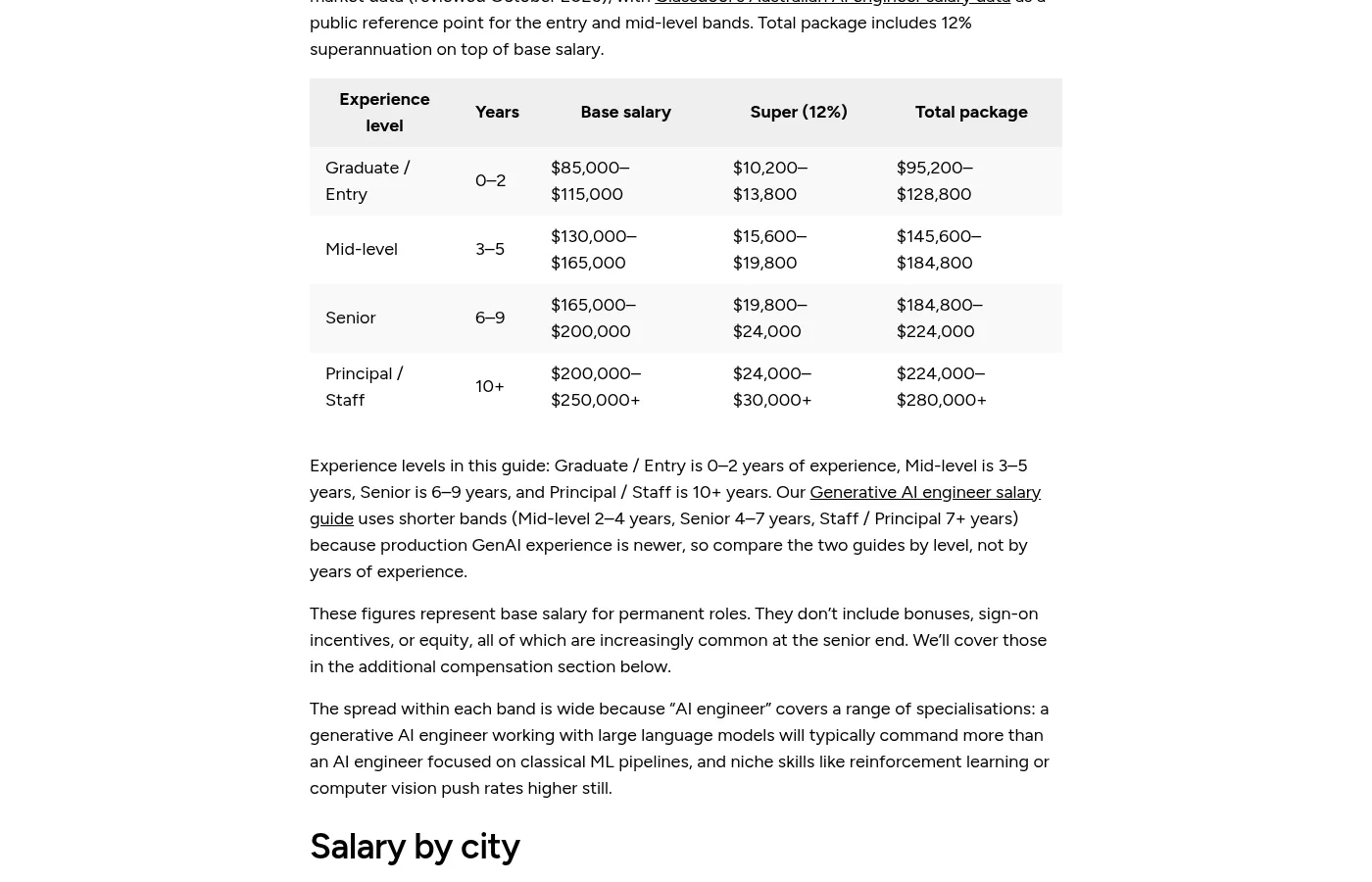
aitalentondemand.com.au AI Engineer Salary AU 2026. AI Engineer base bands by experience level, including $130,000 to $165,000 for mid-level (3 to 5 years). Updated October 2026.
- glassdoor.com.au
Glassdoor AU 2026 (Data Analyst, AI Engineer).
- payscale.com
PayScale AU, Average Software Engineer Salary in Australia. The live Software Engineer page: average base AU$91,457, median A$91k, based on 887 salary profiles, last updated October 2026.
A few honest caveats. The Software Engineer "with AI" figure pulls from the AI Engineer specialist figures. Not every Software Engineer who uses Copilot earns this. The bracket goes to the specialist who shipped the AI feature, not the generalist who autocompletes faster.
The Marketing Manager top of range cross-references AI Automation Engineer roles, which is a cross-discipline cluster. Mechanical to Automation is a real title pivot, not the same role with a new skill.
This is general career and salary information based on public 2026 data, not personal migration, legal, or financial advice. Confirm the current figures and your own situation before you decide.